

Rust you can read.

You get a short Rust program and predict what it does, or find the line the compiler refuses. Then the app walks through it line by line: who owns each value, when it moves, and when it’s dropped.

iOS only for now

Try a card
Assigning a String moves it.
A card from Stage 7, Ownership. Tap Step and watch what each line does.
No Rust knowledge needed. Follow the highlighted line and watch who owns the text.
Output
Variables
Read the card: Assigning a String moves it
With a number, let pass = ticket; would give pass a copy. With a String, no second text is made. The one text gets a new owner: it moves from ticket to pass. After the move pass owns the text, and ticket owns nothing. Step through and watch both variables.
Your turn

Correct!
+5 XP
The card and the question are the ones in the app, word for word.
Inside the app
What the Rust course looks like.
Screens from the Rust course, on an iPhone.
-
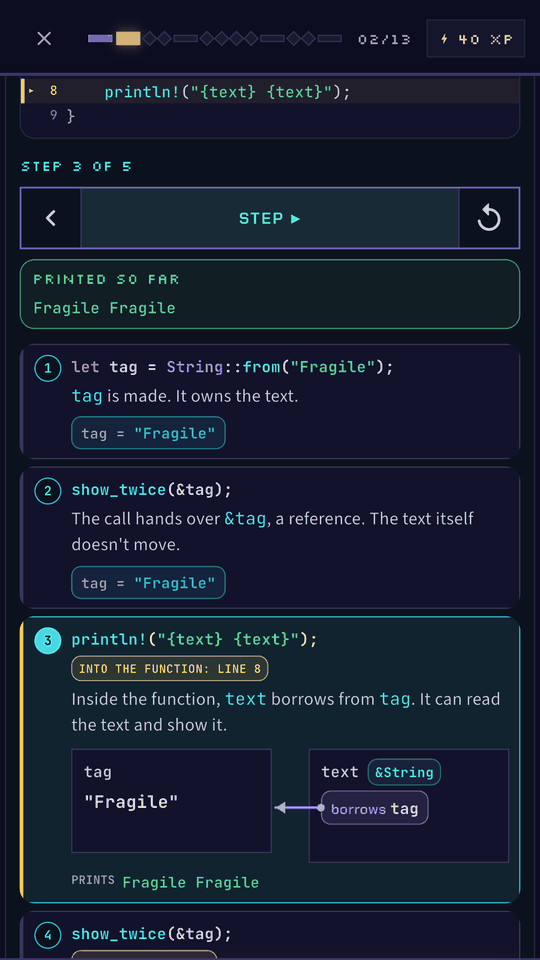
Who owns it, who borrows it -
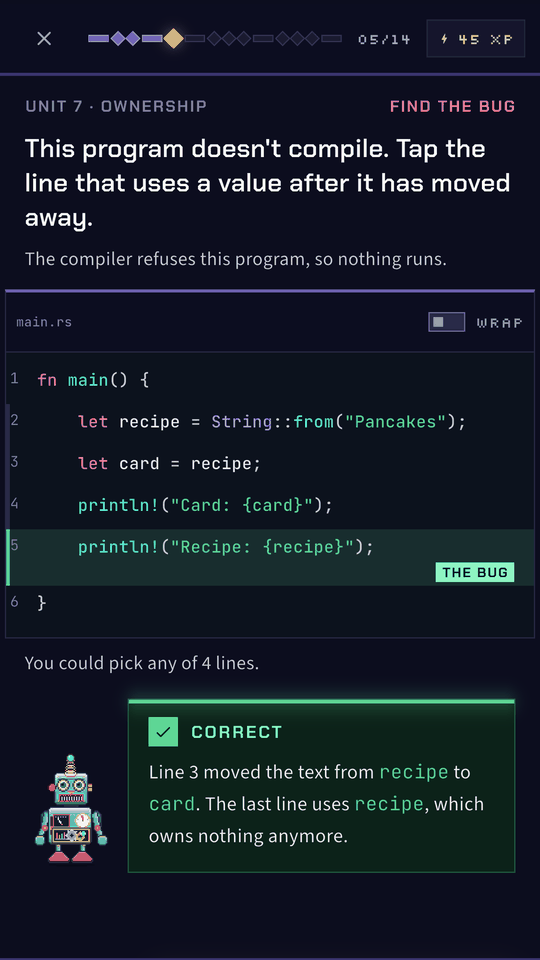
Find the line the compiler refuses -
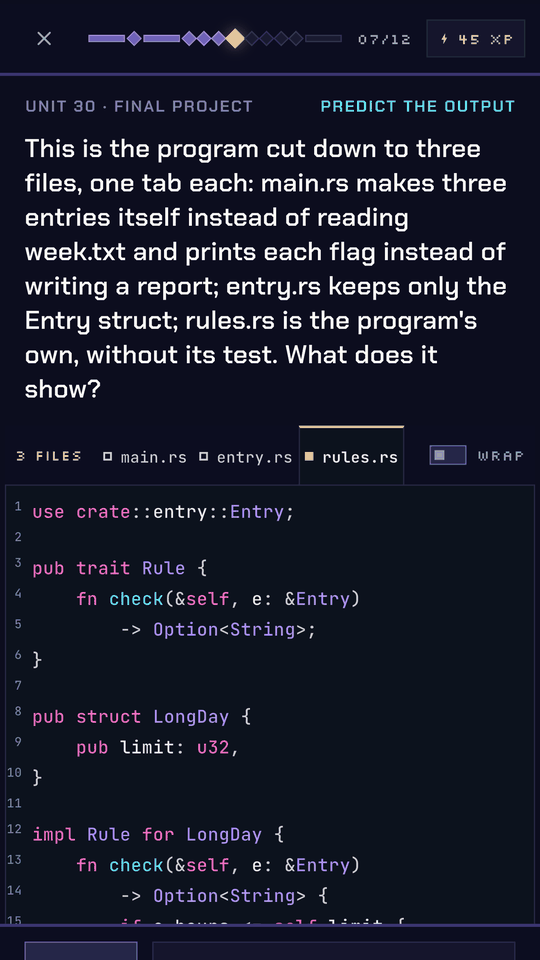
One program, three files -
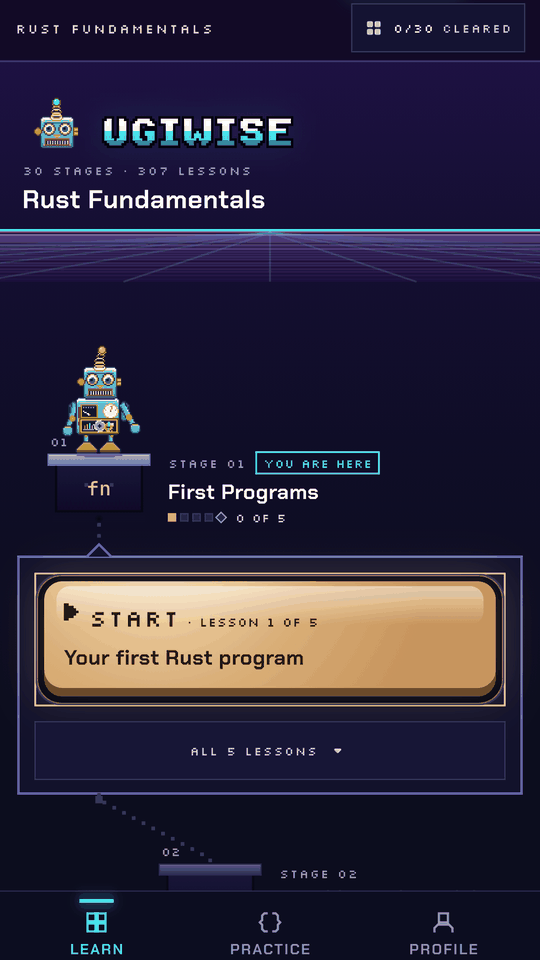
See where you are


The course
30 stages, in this order.
From your first program to ownership, borrowing, traits and threads, ending in a final project.
- First Programs
- Variables and Mutability
- Numbers and Basic Types
- Making Decisions
- Loops
- Functions
- Ownership
- References and Borrowing
- Strings and Slices
- Tuples and Arrays
- Structs
- Methods
- Enums and match
- Option
- Patterns
- Vectors
- Hash Maps
- Error Handling
- Generics
- Modules, Crates and Tests
- Traits
- Lifetimes
- Closures
- Iterators
- Trait Objects and Operators
- Smart Pointers
- Files and I/O
- Concurrency
- Macros and unsafe
- Final Project
Get Ugiwise on your iPhone
- iOS only for now.
- Stages 1 to 3 are free, and no account is required.
- Stages 4 to 30 are a paid upgrade.
- The course is written to Rust 2024.
- The app doesn’t compile or run code on your phone. You read programs, predict what they print, find the line that breaks, answer multiple-choice questions and fill in the missing code.